

 Govibe Reseach
 PDFeditor With Ai
 Audio Studio
 Photoeffect
 Textediting With Ai
 Videoconverter
 Aispreadsheet
 Photostudio
 WatermarkRemover
 Govibe Music Studio
 Electronic frequency generator
 Audio Converter
 Software Download Page
 Govibe App Installation
The Very First Electric Lamp Was NOT Made by Edison
Long before Thomas Edison became famous for commercializing the incandescent bulb, the true earliest electric lamps were created by Sir Humphry Davy in the early 19th century—decades before Edison was even born. Davy’s experiments in 1802 and 1809 mark the real origin of electric lighting, and the difference between the two designs shows how rapidly electrical science was evolving.
Davy’s 1802 Lamp — The First Spark of Electric Light
In 1802, just two years after Volta introduced the first battery (the voltaic pile), Humphry Davy began experimenting at the Royal Institution.
Battery Power
Davy used a small voltaic pile—only a few hundred plates.
The power was limited, but enough to explore how electricity interacted with different materials.
Lamp Design
Two charcoal rods (carbon electrodes) were connected directly to the battery.
When the rods touched and were pulled slightly apart, a small, brief spark or weak glow appeared.
Performance
The light was faint and short-lived.
In the same year, Davy also heated a platinum strip to incandescence using electricity—an early ancestor of the incandescent filament.
This was the first time in human history that electricity produced light in a controllable way.
But it was only the beginning.
Davy’s 1809 Lamp — The First True Electric Lamp
Davy’s 1809 demonstration changed everything. This was no longer a scientific curiosity—this was the first powerful, sustained electric light ever shown to the public.
Battery Power
The breakthrough came from an enormous 2,000-cell battery, one of the most powerful electrical sources on Earth at the time.
This massive battery produced far higher voltage and current than his earlier experiments.
The same battery also allowed Davy to isolate new elements like sodium and potassium.
Lamp Design
Two horizontal carbon rods were connected to the battery.
When separated slightly, a bright electric arc formed between the tips.
Performance
This was the world’s first electric arc lamp.
The arc could stretch up to 4 inches (100 mm).
Witnesses said the light was as bright as the sun, flooding the room with intense white-blue illumination.
Davy called it an “arch lamp” because the arc bent upward due to rising hot air.
The major limitation:
The carbon rods burned away quickly, making it impractical for daily use—yet it proved for the first time that electricity could produce powerful artificial light.
Conclusion
The core principle in both 1802 and 1809 was the same—using electricity to heat or excite carbon until it glowed.
But the scale of power changed everything.
1802: The first spark of electric light.
1809: The first true electric lamp—decades before Edison.
Edison did not invent electric light.
He perfected the long-lasting, commercially viable incandescent bulb, but the first electric lamps belonged to Humphry Davy, the true pioneer of electric illumination.
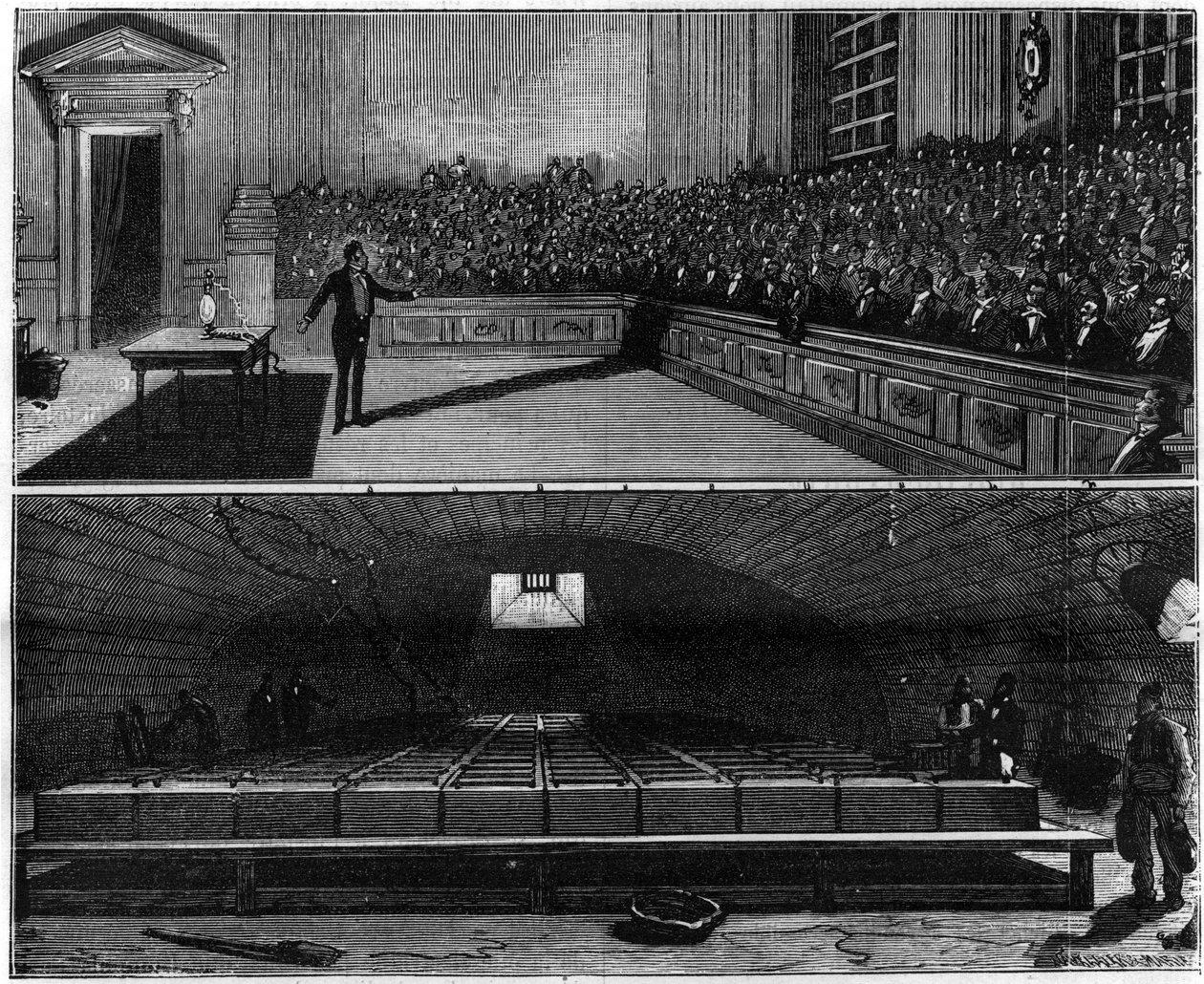
This engraving shows:
1 : Humphry Davy demonstrating electric light
2 : The gigantic voltaic battery that powered the first arc lamp
Long before Thomas Edison became famous for commercializing the incandescent bulb, the true earliest electric lamps were created by Sir Humphry Davy in the early 19th century—decades before Edison was even born. Davy’s experiments in 1802 and 1809 mark the real origin of electric lighting, and the difference between the two designs shows how rapidly electrical science was evolving.
Davy’s 1802 Lamp — The First Spark of Electric Light
In 1802, just two years after Volta introduced the first battery (the voltaic pile), Humphry Davy began experimenting at the Royal Institution.
Battery Power
Davy used a small voltaic pile—only a few hundred plates.
The power was limited, but enough to explore how electricity interacted with different materials.
Lamp Design
Two charcoal rods (carbon electrodes) were connected directly to the battery.
When the rods touched and were pulled slightly apart, a small, brief spark or weak glow appeared.
Performance
The light was faint and short-lived.
In the same year, Davy also heated a platinum strip to incandescence using electricity—an early ancestor of the incandescent filament.
This was the first time in human history that electricity produced light in a controllable way.
But it was only the beginning.
Davy’s 1809 Lamp — The First True Electric Lamp
Davy’s 1809 demonstration changed everything. This was no longer a scientific curiosity—this was the first powerful, sustained electric light ever shown to the public.
Battery Power
The breakthrough came from an enormous 2,000-cell battery, one of the most powerful electrical sources on Earth at the time.
This massive battery produced far higher voltage and current than his earlier experiments.
The same battery also allowed Davy to isolate new elements like sodium and potassium.
Lamp Design
Two horizontal carbon rods were connected to the battery.
When separated slightly, a bright electric arc formed between the tips.
Performance
This was the world’s first electric arc lamp.
The arc could stretch up to 4 inches (100 mm).
Witnesses said the light was as bright as the sun, flooding the room with intense white-blue illumination.
Davy called it an “arch lamp” because the arc bent upward due to rising hot air.
The major limitation:
The carbon rods burned away quickly, making it impractical for daily use—yet it proved for the first time that electricity could produce powerful artificial light.
Conclusion
The core principle in both 1802 and 1809 was the same—using electricity to heat or excite carbon until it glowed.
But the scale of power changed everything.
1802: The first spark of electric light.
1809: The first true electric lamp—decades before Edison.
Edison did not invent electric light.
He perfected the long-lasting, commercially viable incandescent bulb, but the first electric lamps belonged to Humphry Davy, the true pioneer of electric illumination.
This engraving shows:
1 : Humphry Davy demonstrating electric light
2 : The gigantic voltaic battery that powered the first arc lamp
The Very First Electric Lamp Was NOT Made by Edison
Long before Thomas Edison became famous for commercializing the incandescent bulb, the true earliest electric lamps were created by Sir Humphry Davy in the early 19th century—decades before Edison was even born. Davy’s experiments in 1802 and 1809 mark the real origin of electric lighting, and the difference between the two designs shows how rapidly electrical science was evolving.
Davy’s 1802 Lamp — The First Spark of Electric Light
In 1802, just two years after Volta introduced the first battery (the voltaic pile), Humphry Davy began experimenting at the Royal Institution.
Battery Power
Davy used a small voltaic pile—only a few hundred plates.
The power was limited, but enough to explore how electricity interacted with different materials.
Lamp Design
Two charcoal rods (carbon electrodes) were connected directly to the battery.
When the rods touched and were pulled slightly apart, a small, brief spark or weak glow appeared.
Performance
The light was faint and short-lived.
In the same year, Davy also heated a platinum strip to incandescence using electricity—an early ancestor of the incandescent filament.
This was the first time in human history that electricity produced light in a controllable way.
But it was only the beginning.
Davy’s 1809 Lamp — The First True Electric Lamp
Davy’s 1809 demonstration changed everything. This was no longer a scientific curiosity—this was the first powerful, sustained electric light ever shown to the public.
Battery Power
The breakthrough came from an enormous 2,000-cell battery, one of the most powerful electrical sources on Earth at the time.
This massive battery produced far higher voltage and current than his earlier experiments.
The same battery also allowed Davy to isolate new elements like sodium and potassium.
Lamp Design
Two horizontal carbon rods were connected to the battery.
When separated slightly, a bright electric arc formed between the tips.
Performance
This was the world’s first electric arc lamp.
The arc could stretch up to 4 inches (100 mm).
Witnesses said the light was as bright as the sun, flooding the room with intense white-blue illumination.
Davy called it an “arch lamp” because the arc bent upward due to rising hot air.
The major limitation:
The carbon rods burned away quickly, making it impractical for daily use—yet it proved for the first time that electricity could produce powerful artificial light.
Conclusion
The core principle in both 1802 and 1809 was the same—using electricity to heat or excite carbon until it glowed.
But the scale of power changed everything.
1802: The first spark of electric light.
1809: The first true electric lamp—decades before Edison.
Edison did not invent electric light.
He perfected the long-lasting, commercially viable incandescent bulb, but the first electric lamps belonged to Humphry Davy, the true pioneer of electric illumination.
This engraving shows:
1 : Humphry Davy demonstrating electric light
2 : The gigantic voltaic battery that powered the first arc lamp